

In today’s newsletter:
A shared space for personal AI assistants.
How to fine-tune LLMs in 2026.
One architectural change can cut KV cache by 8x!
A shared space for personal AI assistants
People usually use an AI assistant to work through their own files or notes. It has context about one person’s work and responds to that person’s requests.
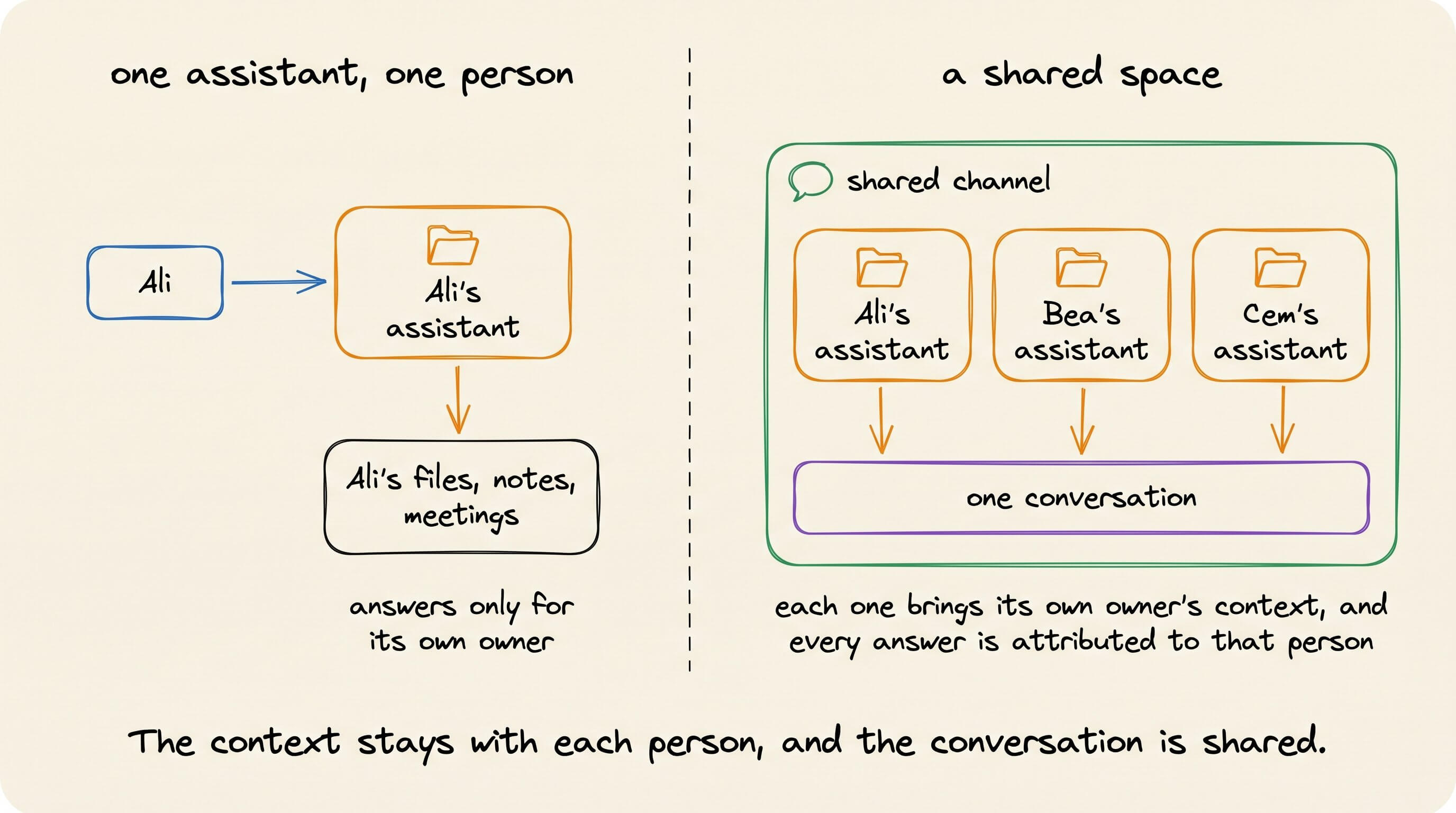
Rowboat Spaces (open-source) extends that setup to a team conversation. Each person brings their own assistant into a shared channel, with access to their own meetings, notes, and open decisions.
A team member can ask their assistant to contribute what they know. The answer appears in the channel, attributed to that person. Other members can bring in context through their assistants in the same way.
The assistants can also work with the channel history. As a team discusses a spec, they can draft and update the shared file, with each change linked to the message that prompted it.
We created a shared space, invited a team member, and asked them for a status update. They asked their assistant to answer using their own context. We then built a spec from that conversation, versioned it, and tracked each change back to the message that prompted it.
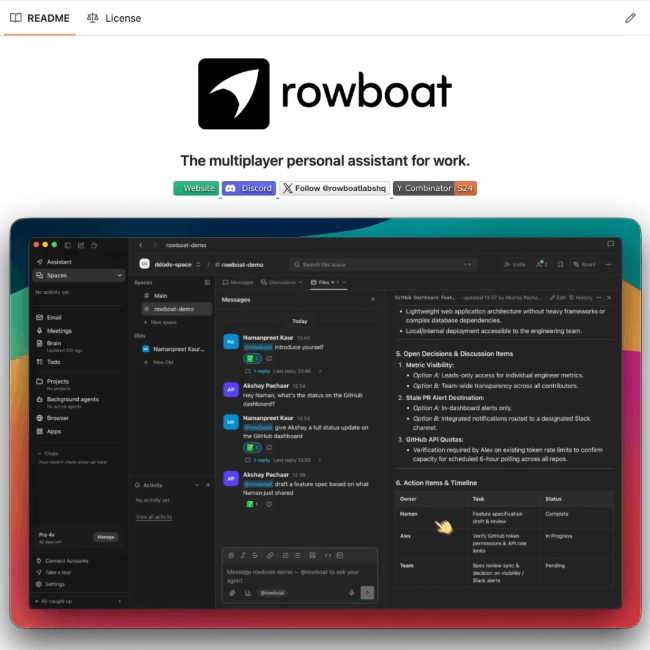
Rowboat GitHub: https://github.com/rowboatlabs/rowboat
(don’t forget to star 🌟)
How to fine-tune LLMs in 2026
If you’re using GPT or Claude, you’re using the same model as everyone else, with the same capabilities, the same cost, and no competitive edge.
But if you take a small open-source model and fine-tune it on your specific task, it can outperform a model 100x its size, at a fraction of the cost and latency.
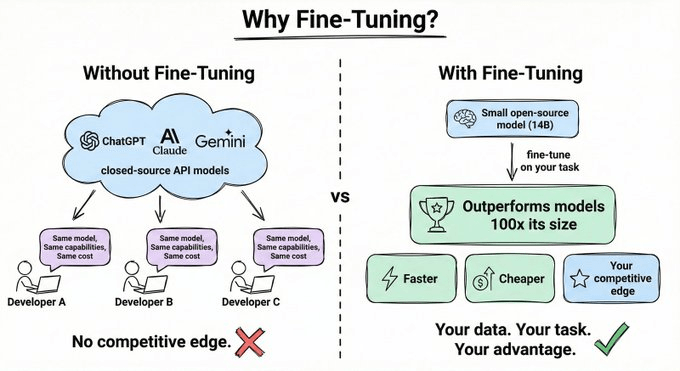
Devs typically associate fine-tuning with a painful setup, like curating datasets, labeling outputs, and hand-crafting reward functions.
In 2026, that’s no longer the case.
Modern fine-tuning using GRPO and RULER is redefining fine-tuning.
You can now train agents that genuinely improve through experience, without writing a single reward function or collecting a single labeled example.
Today, let’s walk through exactly how!
SFT vs. Reinforcement Fine-Tuning
In supervised fine-tuning (SFT), you collect input-output pairs and the model learns to imitate them.
The problem is that SFT teaches the model what to say, not how to succeed.
For agents that search, call APIs, and reason across multiple steps, imitation isn’t enough. You want improvement through trial and error.
Think of it this way:
SFT = studying a textbook (memorizing answers to known questions)
RL = on-the-job training (learning from trial, error, and feedback)

This is Reinforcement Fine-Tuning (RFT). You give the model a reward signal and let it discover the best strategies on its own.
How GRPO Works
GRPO (Group Relative Policy Optimization) is the most popular RFT algorithm today. It’s the same algorithm that powered DeepSeek-R1’s reasoning capabilities.
Essentially, instead of training a separate model to score responses, GRPO generates multiple completions and grades them relative to each other.
Here’s how it works for each prompt:
Sample a group: Generate N completions from the current model
Score each one: A reward function evaluates each attempt
Normalize within the group: Calculate relative advantage vs. the group average
Update the model: Reinforce above-average behaviors, suppress below-average ones
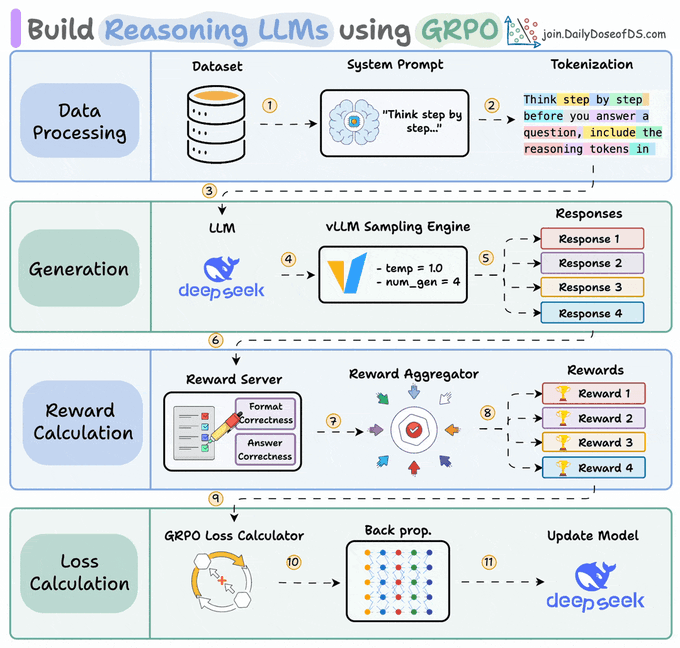
GRPO only needs relative rankings, not absolute scores. Whether completions score 0.3, 0.5, and 0.7 or 30, 50, and 70 doesn’t matter. Only the ordering drives learning.
ART: Agent Reinforcement Trainer
GRPO is powerful, but how do you actually apply it to a real-world agent?
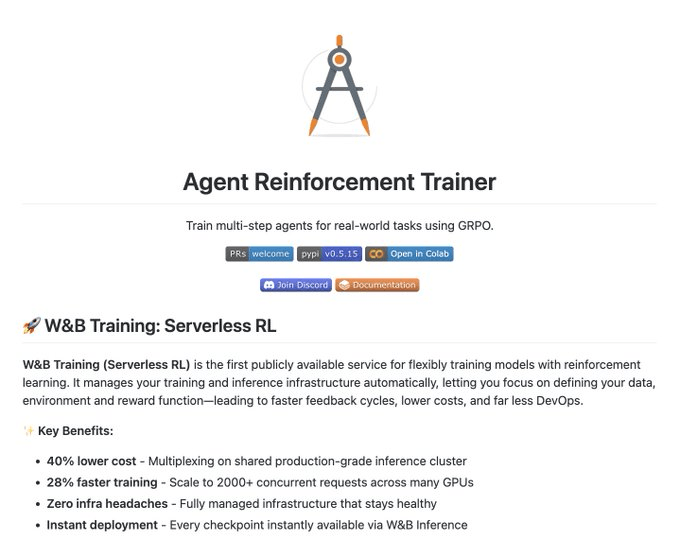
ART (Agent Reinforcement Trainer) is a 100% open-source framework that brings GRPO to any Python application.
Most RL frameworks are built for simple chatbot interactions, involving one input, one output, and the job is done.
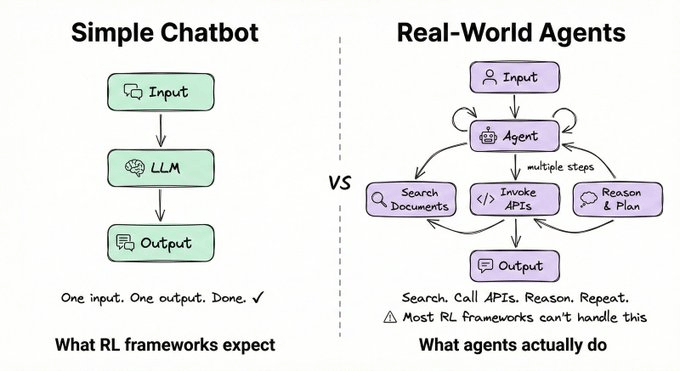
Real agents are fundamentally different. They search documents, invoke APIs, and reason across multiple steps before producing an answer.
ART is built for exactly this. It provides:
Native support for tool calls and multi-turn conversations
Integrations with LangGraph, CrewAI, and ADK
Efficient GPU utilization during training
Architecture
ART splits into two parts: a Client and a Backend.
The Client is where your agent code lives. It sends inference requests to the backend and records every action into a Trajectory, the complete history of one agent run.
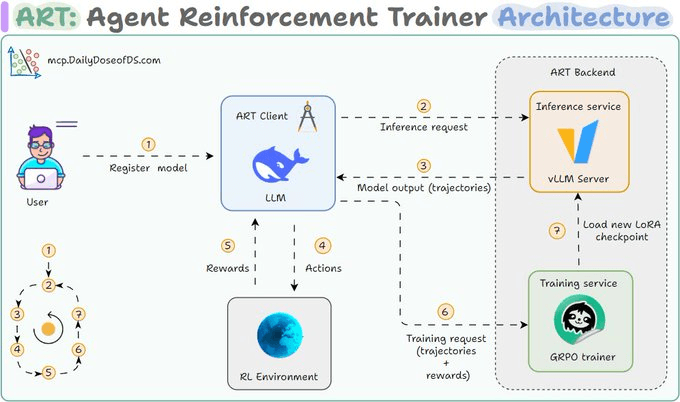
The Backend is where the heavy lifting happens. It runs vLLM for fast inference and Unsloth-powered GRPO for training. After each training step, a new LoRA checkpoint loads automatically into the inference server.
The full training loop
Client sends an inference request
Backend generates model outputs
Agent takes actions in the environment (tool calls, searches, etc.)
Environment returns a reward
Trainer updates the model via GRPO
A new LoRA checkpoint loads into the inference server
Repeat, with each cycle, the model gets a little better than before
RULER: RL without manual reward functions
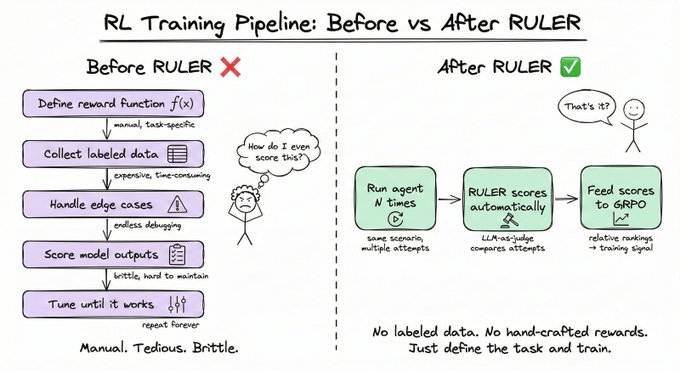
Defining a good reward function has always been the hardest part of RL.
Training an email agent requires labeled correct answers. Training a code agent requires test suites. Each one is its own unique engineering project.
RULER (Relative Universal LLM-Elicited Rewards) eliminates this bottleneck entirely. It uses an LLM-as-judge to compare multiple agent trajectories and rank them, with no labeled data required.
It works because of two key insights:
Asking an LLM “rate this 0-10” produces inconsistent results
Asking “which of these 4 attempts best achieved the goal?” is far more reliable.
And since GRPO only needs relative scores, the absolute values don’t matter anyway.
The process is three steps:
Generate N trajectories for a scenario
Pass them to an LLM judge, which scores each from 0 to 1
Use those scores directly as rewards in GRPO
A practical example
We put together a fully working notebook that trains a 3B model to master how to use any MCP server through reinforcement learning using ART.
Simply provide an MCP server URL, and the notebook will:
Query the server’s tools
Generate a set of input tasks that use those tools
Train the model on those tasks using automatic RULER evaluation
You can find more examples to adapt and get started in the ART GitHub repo.
One architectural change can cut KV cache by 8x!
In standard multi-head attention, every query head gets its own key and value head.
So a model with 64 query heads therefore stores 64 sets of key and value vectors for every token at every layer.
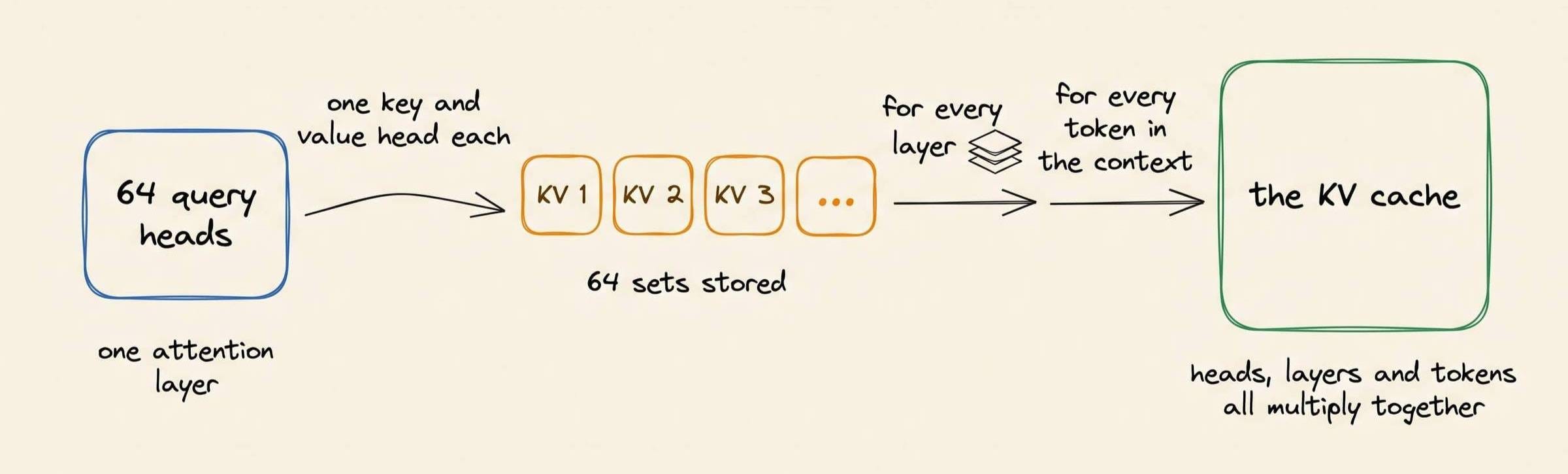
Multi-query attention optimizes this. It shares one KV head across all query heads. This produces the smallest cache, although that much sharing can reduce model quality.
Grouped-query attention lies between them and the visual below explains all three techniques:
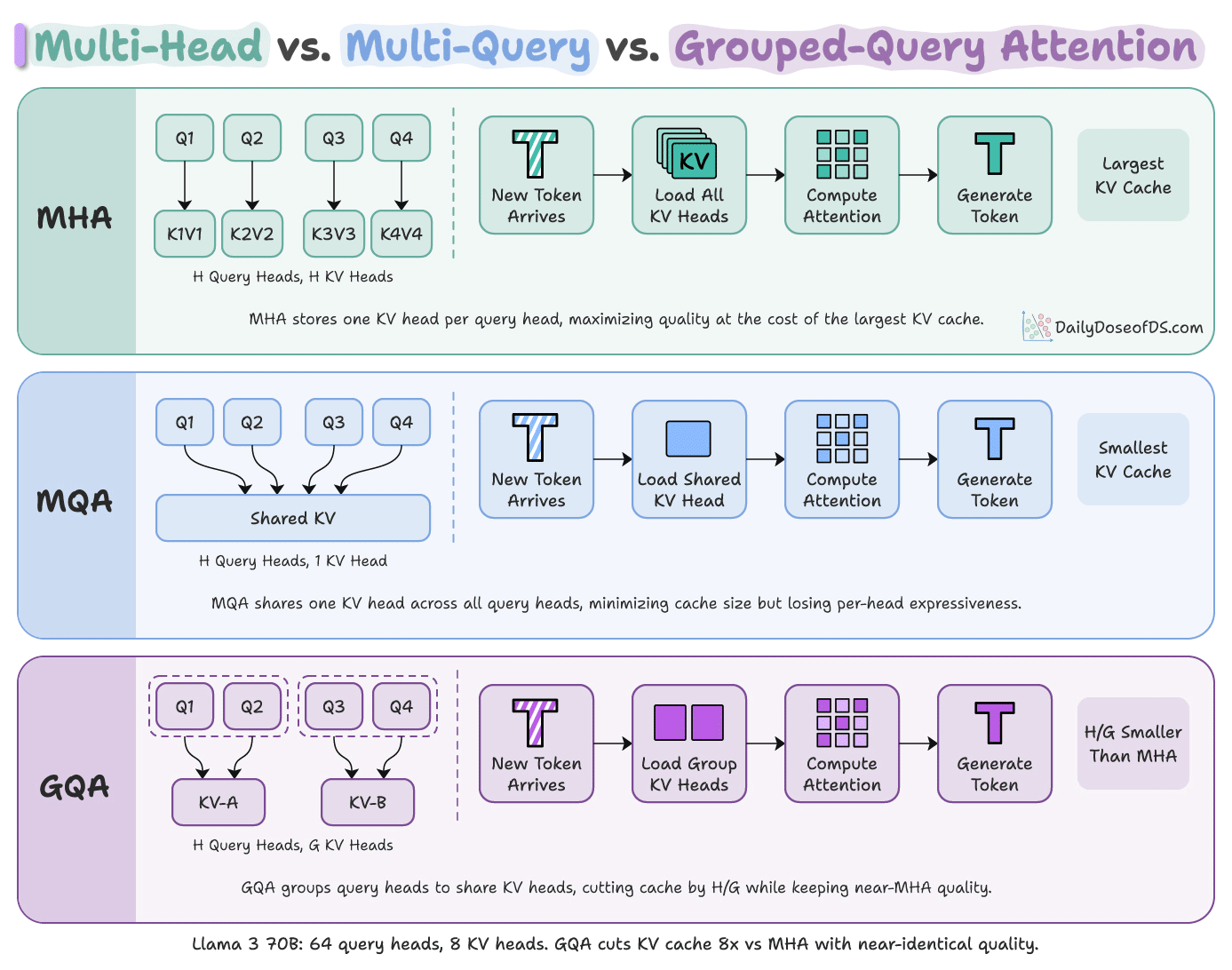
It divides the query heads into groups, with each group sharing one KV head.
In Llama 3 70B, every eight query heads share one KV head. The model stores 8 sets of KV vectors instead of the 64 that an equivalent MHA layout would need.
That makes this part of the KV cache 8x smaller. It also reduces the amount of KV data read during decoding by the same factor, assuming the remaining dimensions and precision stay unchanged.
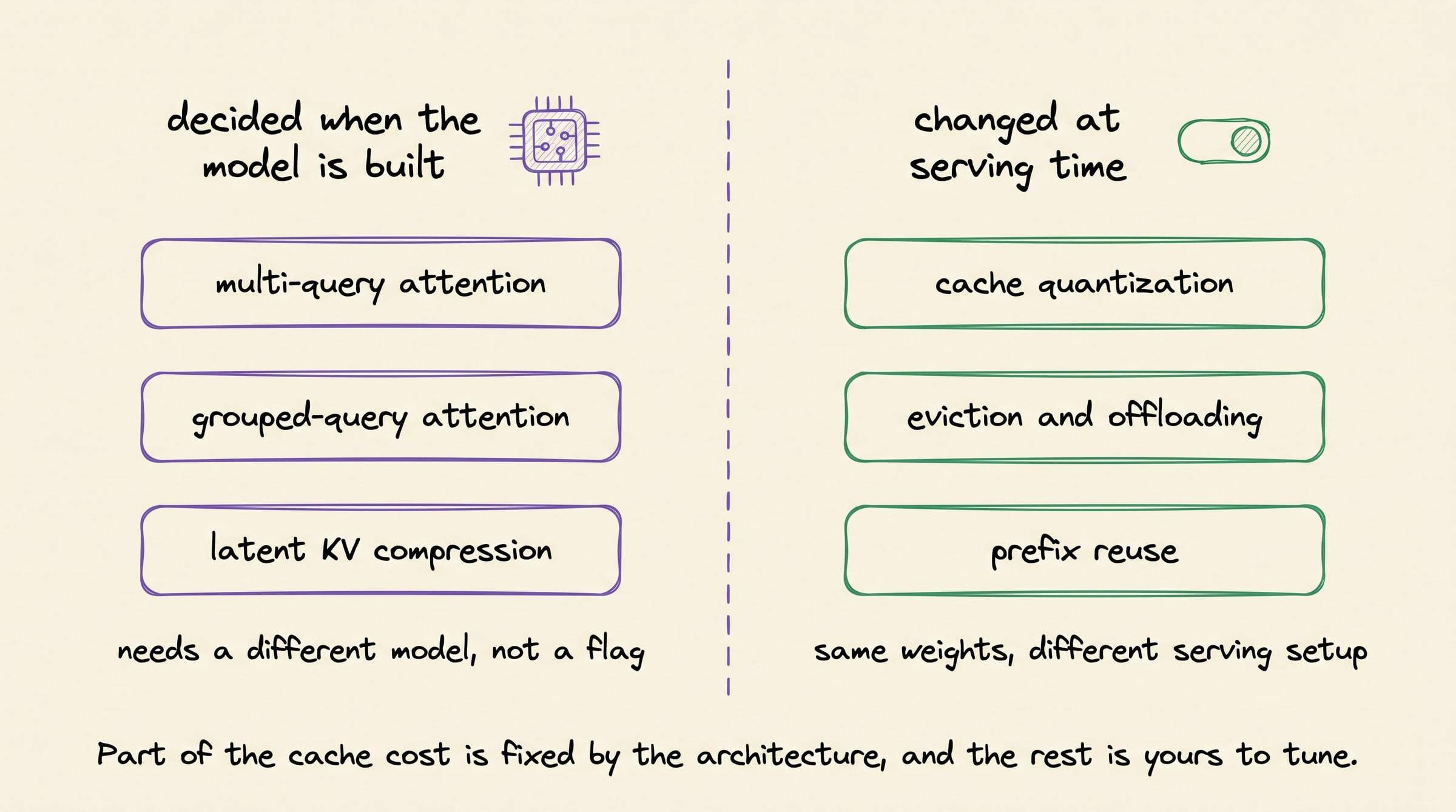
This is part of the model architecture, so it cannot be enabled on an arbitrary MHA model with a serving flag.
And this is only one way to control KV-cache cost.
We covered GQA alongside 11 other methods in the KV Cache Engineering article. It explains which part of the cost each method reduces and whether it requires a different model architecture or only a serving-engine change.
P.S. For those wanting to develop “Industry ML” expertise:

At the end of the day, all businesses care about impact. That’s it!
Can you reduce costs?
Drive revenue?
Can you scale ML models?
Predict trends before they happen?
We have discussed several other topics (with implementations) that align with such topics.
Here are some of them:
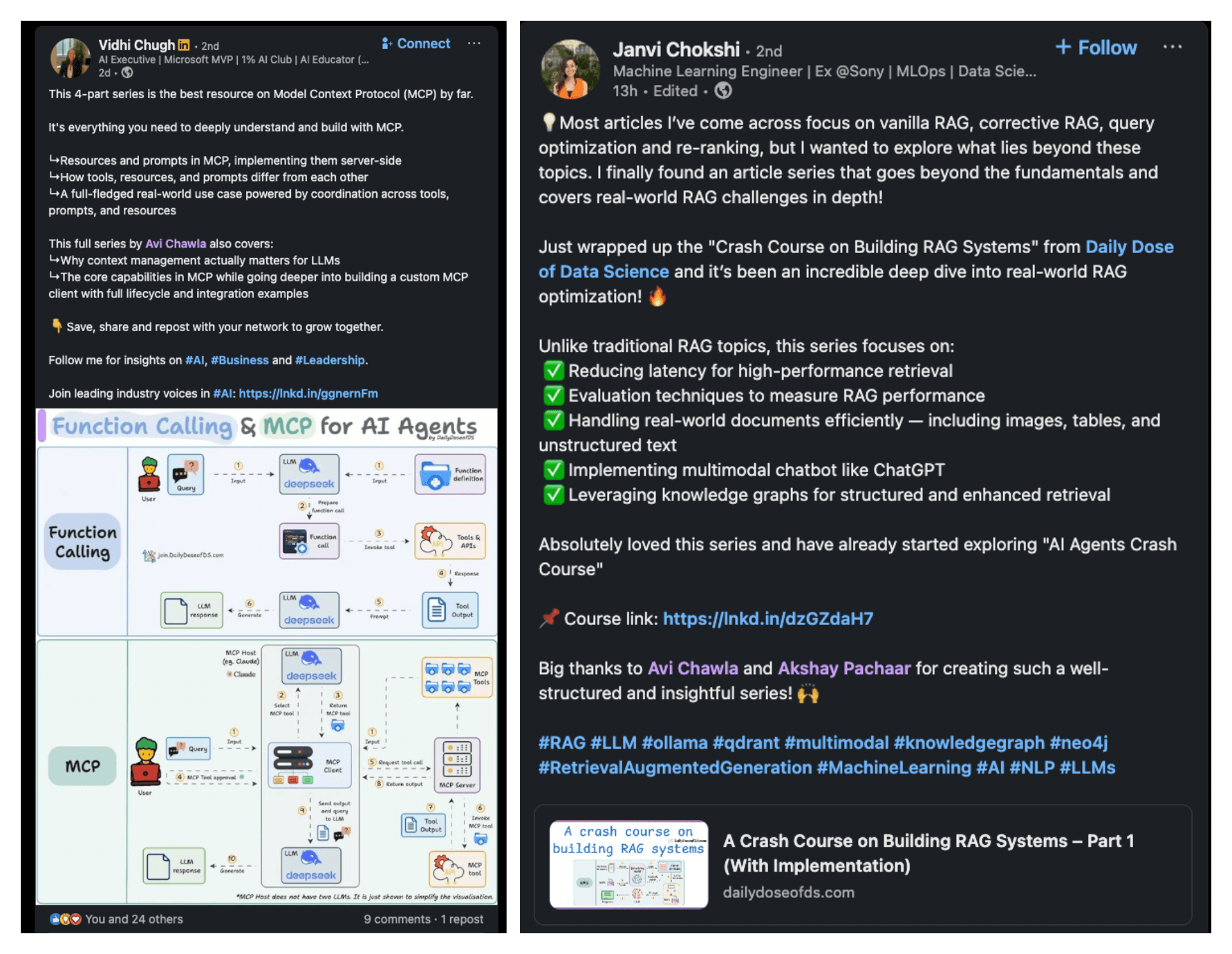
Learn everything about MCPs in this crash course with 9 parts →
Learn how to build Agentic systems in a crash course with 14 parts.
Learn how to build real-world RAG apps and evaluate and scale them in this crash course.
Learn sophisticated graph architectures and how to train them on graph data.
So many real-world NLP systems rely on pairwise context scoring. Learn scalable approaches here.
Learn how to run large models on small devices using Quantization techniques.
Learn how to generate prediction intervals or sets with strong statistical guarantees for increasing trust using Conformal Predictions.
Learn how to identify causal relationships and answer business questions using causal inference in this crash course.
Learn how to scale and implement ML model training in this practical guide.
Learn techniques to reliably test new models in production.
Learn how to build privacy-first ML systems using Federated Learning.
Learn 6 techniques with implementation to compress ML models.
All these resources will help you cultivate key skills that businesses and companies care about the most.
Built two internal assistants last year where the client initially wanted fine-tuning, and both times the real issue was retrieval, not weights. Fine-tuning fixed tone and format; it never fixed the fact that the model didn't know what happened last Tuesday. Worth asking early: is this a knowledge gap or a behavior gap, because they need completely different fixes.