

2 days left before lifetime access price increases by 50%
In 2 days, the price of lifetime access to DailyDoseofDS will increase by 50%.
It gives you lifetime access to DailyDoseofDS at just 2x the yearly price instead of 3x.
Secure your Lifetime Access before pricing increases here →
Pay once and get lifetime access to our existing all-in-one hands-on AI Engineering blueprints + everything we’ll release in the future:
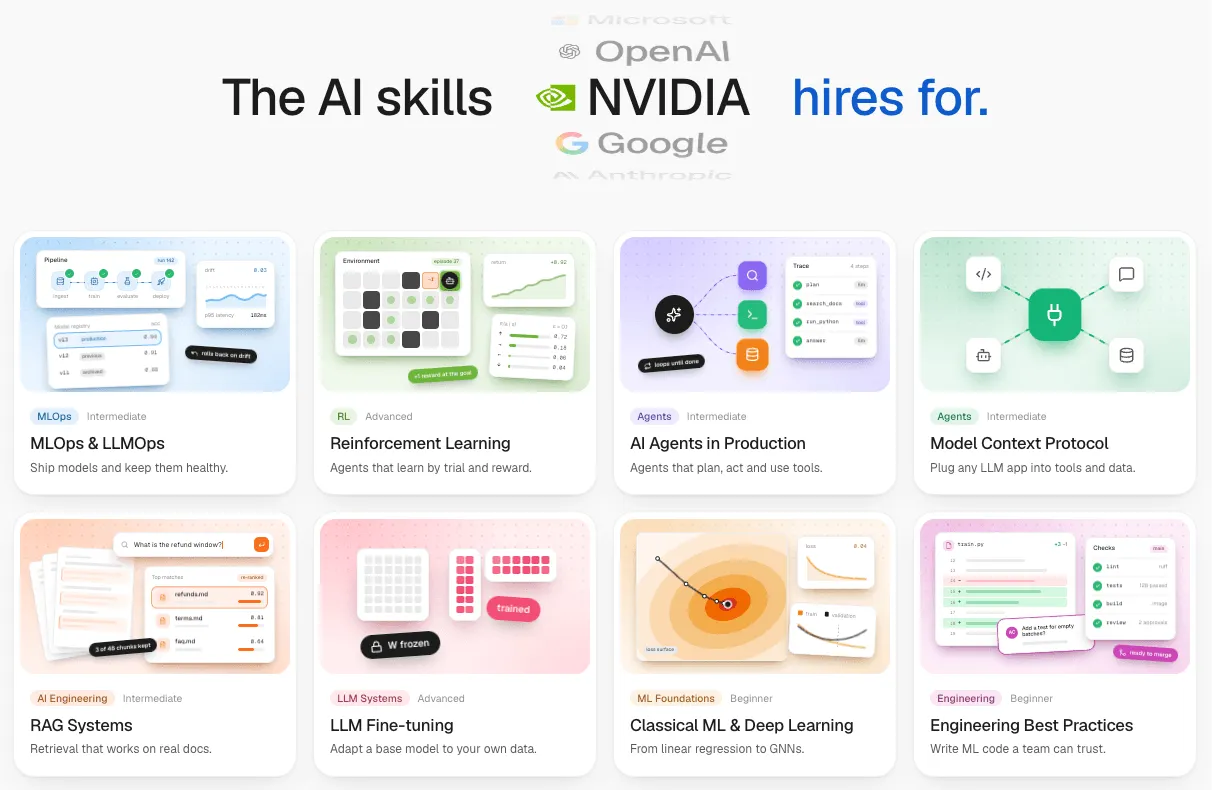
Here’s what you’ll get:
The 13-part RL course, which teaches the core RL algorithms and how AI teams use RL today.
The 17-part course that covers how to build Agentic systems.
Our 18-part MLOps course that goes from first principles to production.
Our 14-part LLMOps course, which teaches you to evaluate, fine-tune, and serve LLMs, so you can own an LLM app after launch.
The full 9-part course on MCPs.
Our 7-part course on building RAG systems.
LLM fine-tuning techniques and implementations.
Our courses on graph neural networks, PySpark, model interpretability, model calibration, causal inference, and more.
Scaling ML models with implementations.
Building privacy-preserving ML systems.
Mathematical deep dives on core DS topics, clustering, etc.
From-scratch implementations of several core ML algorithms.
Building 100% reproducible ML projects.
50+ more existing industry-relevant topics.

You will get all 140+ existing resources plus every new weekly deep dive for life.
Secure your Lifetime Access before pricing increases here →
P.S. Our last sale was ~12 months ago. We don’t run such sales often, so you might not get such discounts again soon.
Join 100k+ people that we helped get promoted, get a better job, or start their own company →
P.P.S. If you are an existing monthly or yearly member and wish to upgrade to lifetime, please reply to this email.
How to test Agents using Agents
Traditional testing relies on fixed inputs and exact outputs. But agents speak in language, and there’s no single “correct” response.
That’s why we test Agents using other Agents by simulating Users and Judges.
Today, let’s understand Agent Testing by building a pipeline to test Agents with other Agents using Scenario.
Our open-source tech stack:
CrewAI for Agent orchestration.
LangWatch Scenario to build the eval pipeline.
PyTest as the test runner.
Here’s what the process looks like:
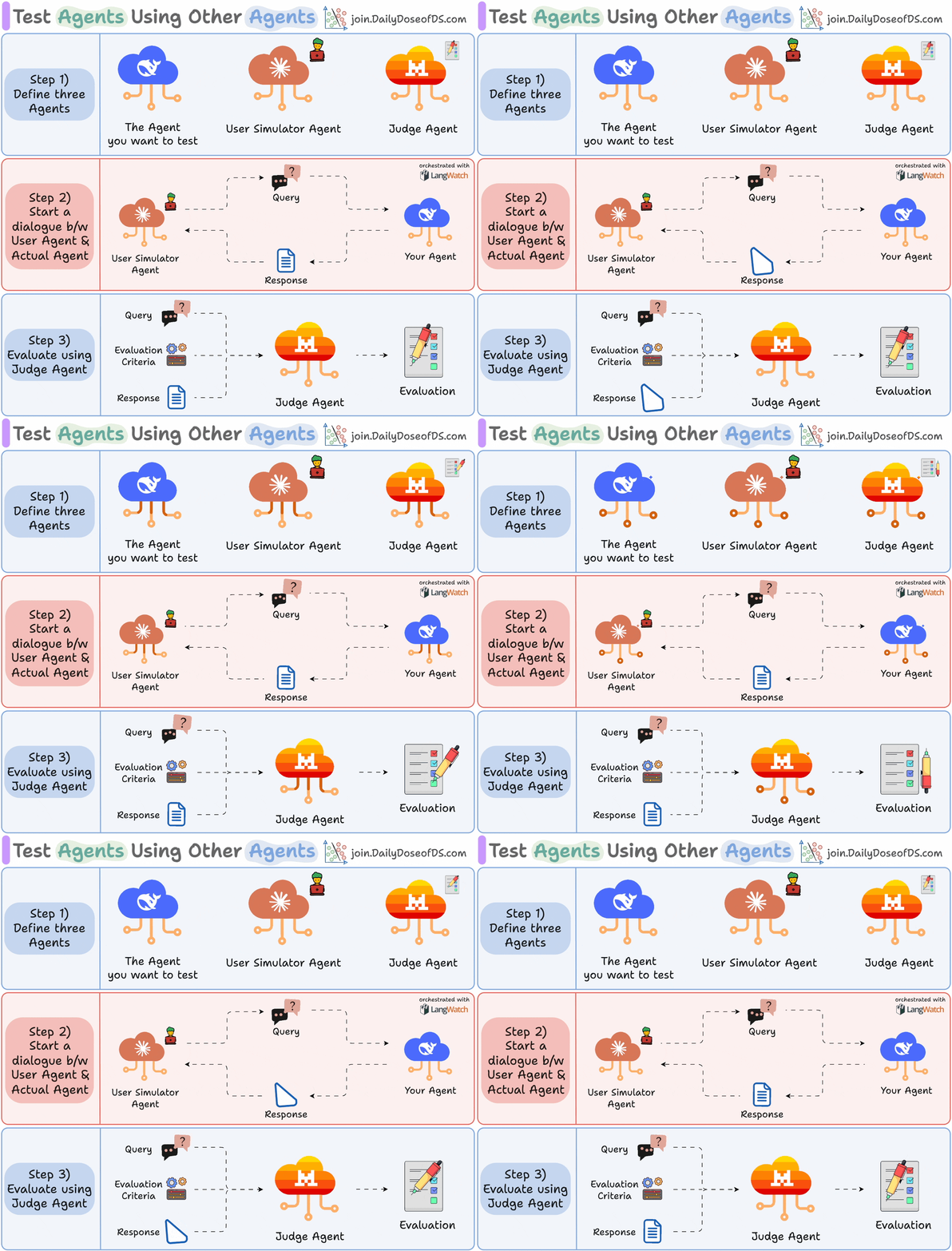
1) Define three Agents:
The Agent you want to test.
A User Simulator Agent that acts like a real user.
A Judge Agent for evaluation.
2) Let your Agent and User Simulator Agent interact with each other.
3) Evaluate the exchange using the Judge Agent based on the specified criteria.
Let’s implement this!
Define Planner Crew
For this demonstration, let’s build a Travel Planner Agent using CrewAI.
It will accept a user query and respond with travel suggestions, a brief itinerary, and an estimated budget.

Configure Crew for testing
In the Scenario library, your Agent class should:

Inherit from the AgentAdapter class.
Define a
call()method that takes the input and returns the output.
Define test
Finally, in our test, we simulate a conversation b/w Travel Agent and User Simulator Agent using the scenario.run method.
After the exchange, a Judge Agent evaluates it using the specified criteria. LangWatch Scenario orchestrates everything!

We specify a name for this test (the
nameparameter).We specify that this test is about (the
descriptionparameter).We specify the agents involved.
Travel Agent: The Agent we want to test.
User Simulator Agent: The Agent that will mimic a real user.
Judge Agent: The Agent that will evaluate the conversation based on the criteria specified in natural language.
Finally, we run the test as follows: uv run pytest -s test_travel_agent.py

As depicted above, the Judge Agent declared it a failed run since it cannot be determined if the location is <4 hrs away, but this was specified in the criteria when we declared the Judge Agent.
Testing revealed a gap, and we can fix this by prompting the Agent to ask for the location if the user did not specify it.
And that’s how you can build pipelines for Agent testing.
The LangWatch Scenario open-source framework orchestrates this process. It is a library-agnostic Agent testing framework based on simulations.
A Memory-efficient Technique to Train Large Models
Activation checkpointing is one technique that’s common to the training procedure of almost all popular large models, GPTs, LLaMAs, etc.
In a gist, it’s super helpful to reduce the memory overhead of large neural networks.
Let’s understand this in more detail.
On a side note, while activation checkpointing is one way, we covered 15 techniques to optimize neural network training here: 15 Ways to Optimize Neural Network Training (With Implementation).
How does Activation checkpointing work?
Activation checkpointing is based on two key observations on how neural networks work:
The activations of a specific layer can be solely computed using the activations of the previous layer. For instance, in the image below, “Layer B” activations can be computed from “Layer A” activations only:

Updating the weights of a layer only depends on two things:
The activations of that layer.
The gradients computed in the next (right) layer (or rather, the running gradients).

Activation checkpointing exploits these two observations to optimize memory utilization.
Here’s how it works:
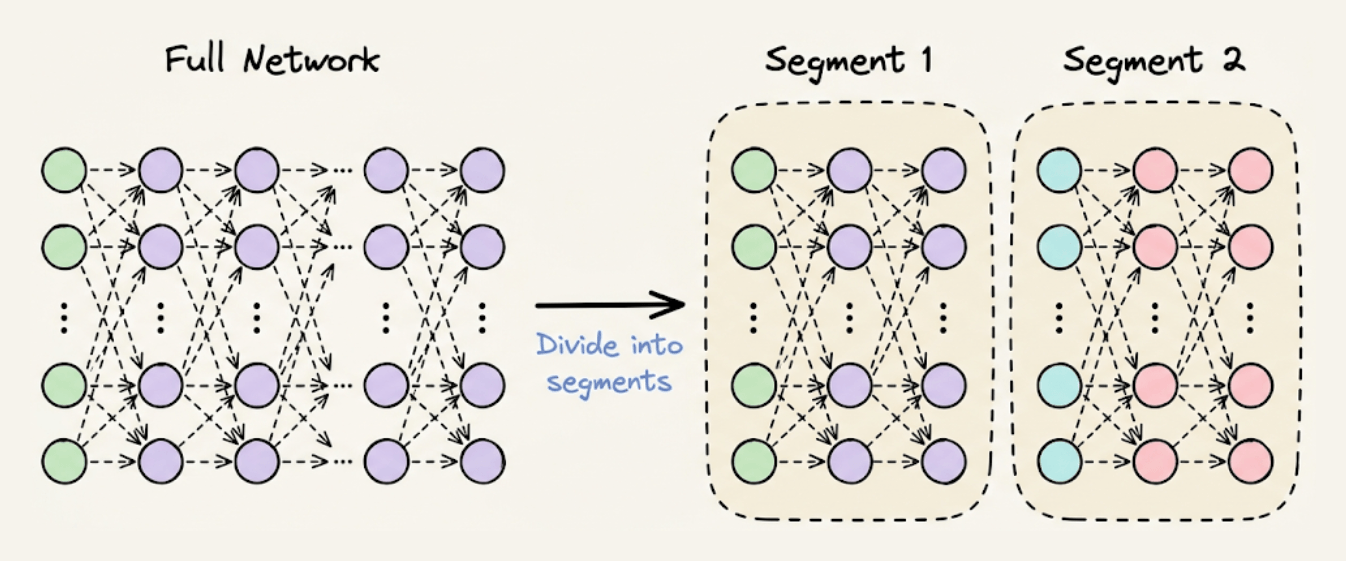
Step 1) Divide the network into segments before the forward pass:
Step 2) During forward pass, store the activations of the first layer only in each segment. Discard the rest when they have been used to compute the activations of their subsequent layer.
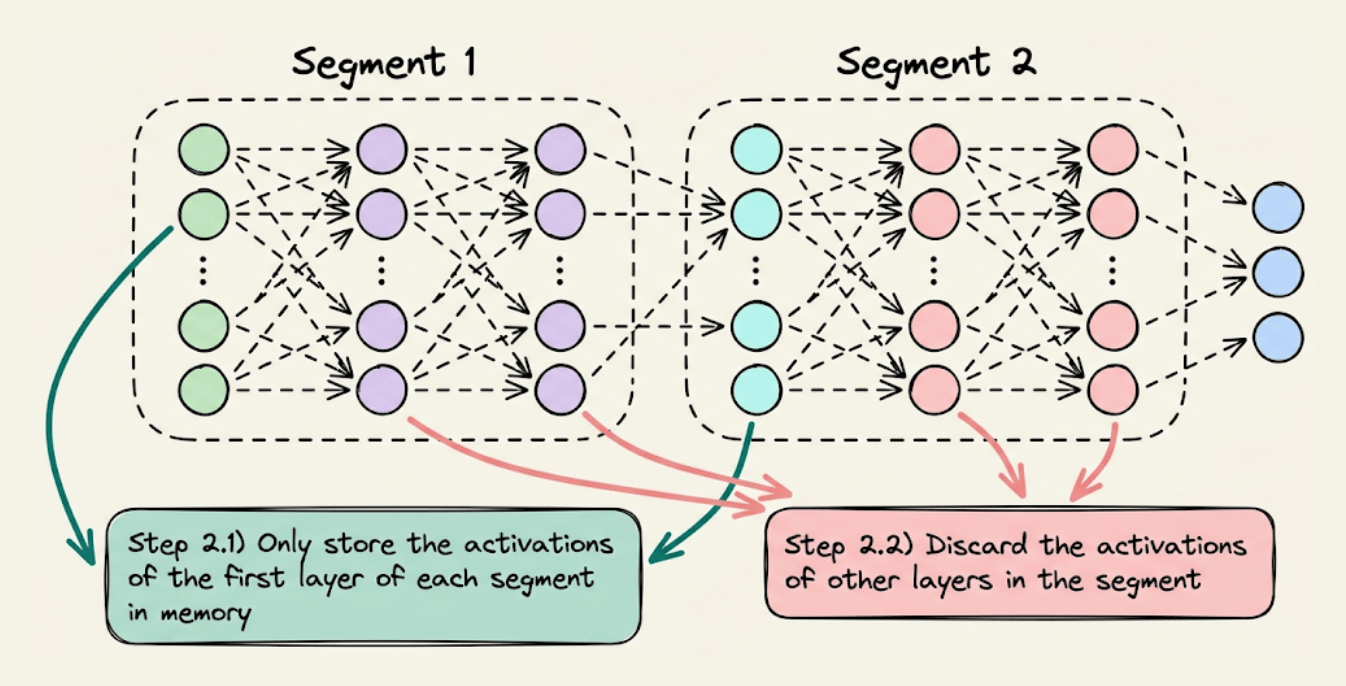
Step 3) Now comes backpropagation. To update the weights of a layer, we need its activations. Thus, we recompute those activations using the first layer in that segment.
For instance, as shown in the image below, to update the weights of the red layers, we recompute their activations using the activations of the cyan layer, which are already available in memory.
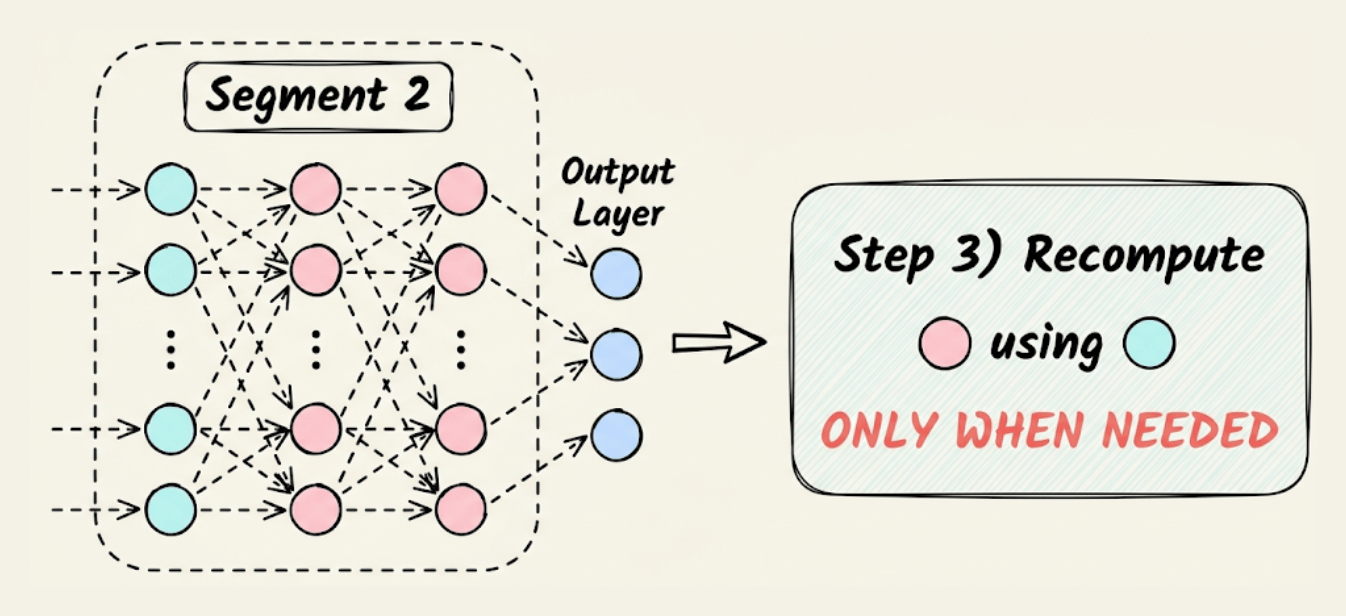
This is how Activation checkpointing works.
To summarize, the idea is that we don’t need to store all the intermediate activations in memory.
Instead, storing a few of them and recomputing the rest only when they are needed can significantly reduce the memory requirement.
Typically, activation checkpointing can reduce memory usage to sqrt(M), where M is the memory usage without activation checkpointing.
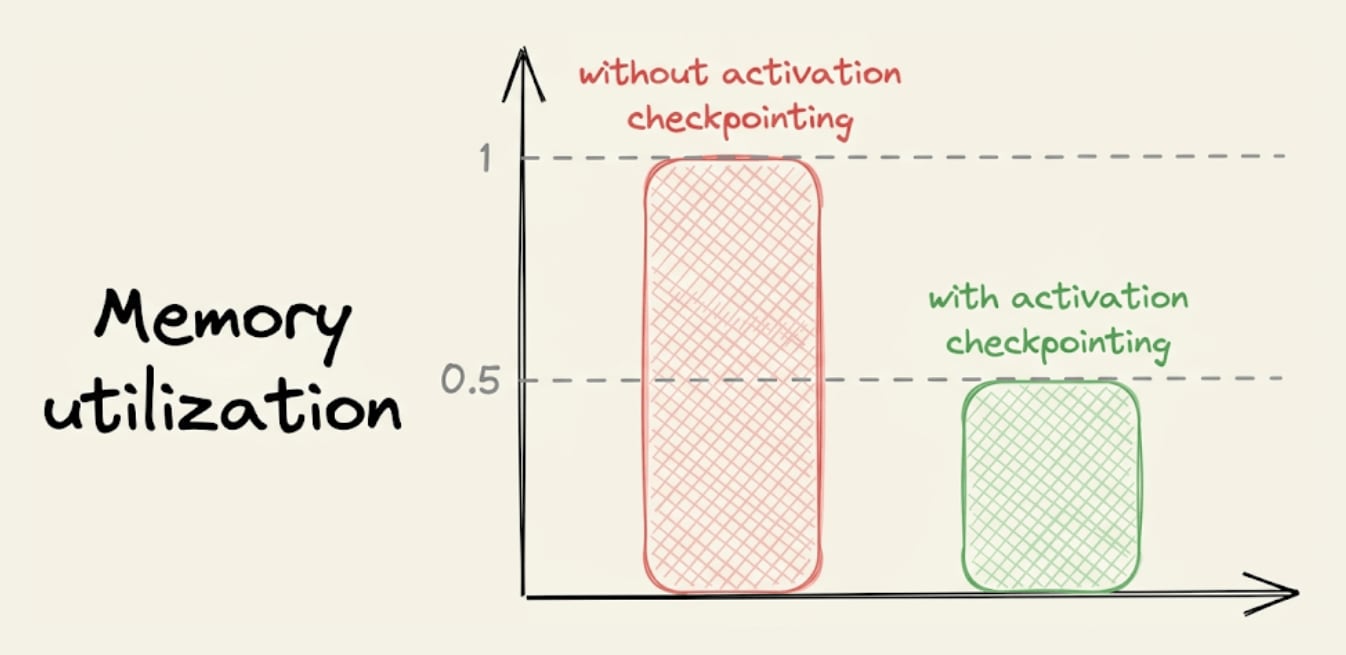
Of course, as we compute some activations twice, this does come at the cost of increased run-time, which can typically range between 15-25%.
So there’s always a tradeoff between memory and run-time.
That said, another advantage is that it allows us to use a larger batch size, which can counter the increased run-time.
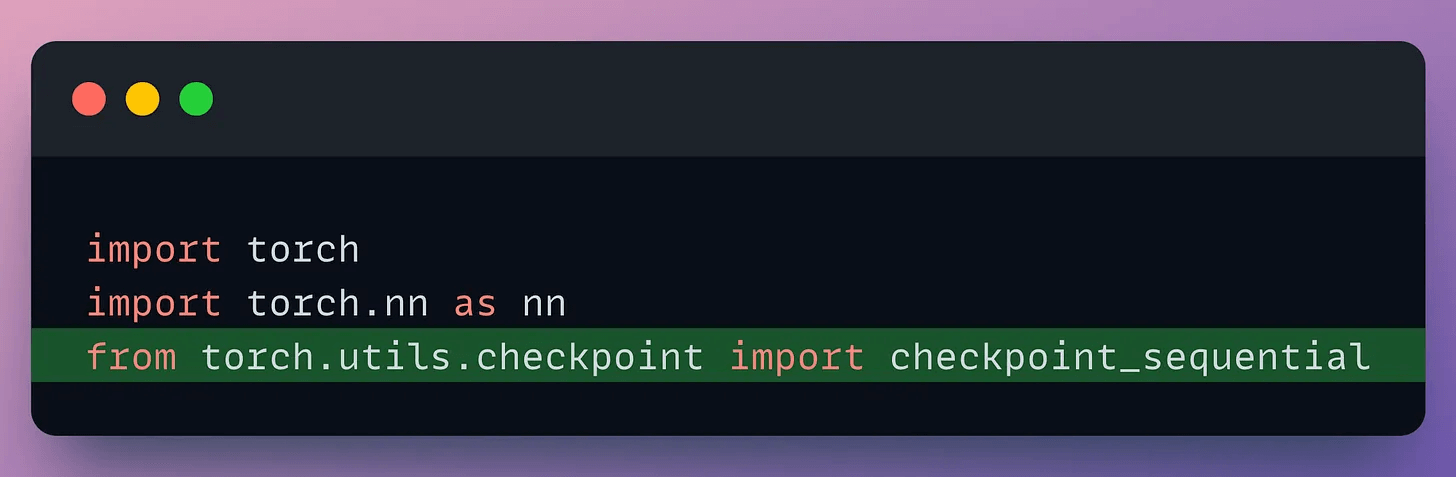
To utilize this, import the necessary libraries and functions:
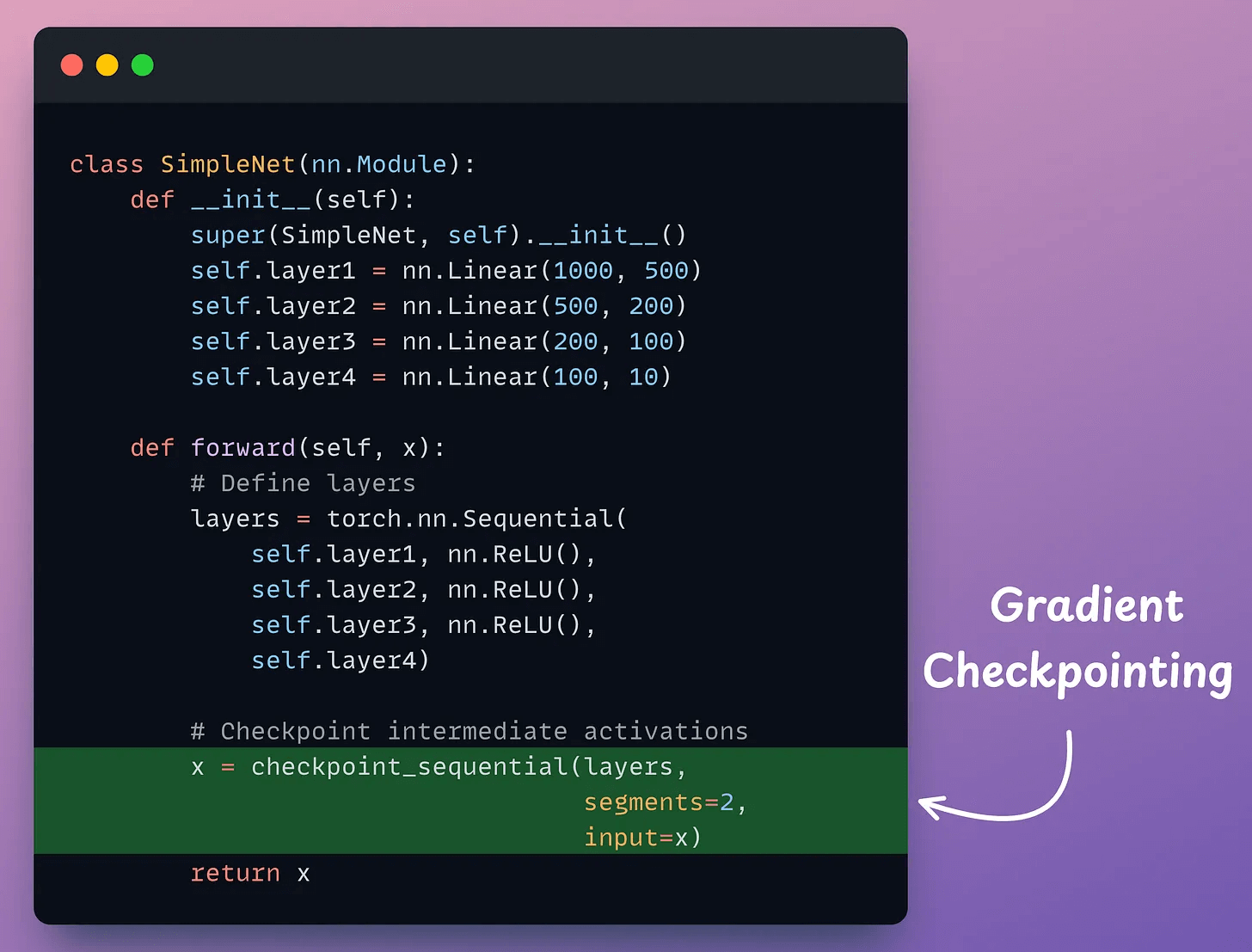
Next, define a neural network:
As demonstrated above, in the forward method, we use the checkpoint_sequential method to use activation checkpointing and divide the network into two segments.
Next, we can proceed with network training as we usually would.
While activation checkpointing is one way, we covered 15 techniques to optimize neural network training here: 15 Ways to Optimize Neural Network Training (With Implementation).
Good day!
P.S. For those wanting to develop “Industry ML” expertise:

At the end of the day, all businesses care about impact. That’s it!
Can you reduce costs?
Drive revenue?
Can you scale ML models?
Predict trends before they happen?
We have discussed several other topics (with implementations) that align with such topics.
Here are some of them:
Learn everything about MCPs in this crash course with 9 parts →
Learn how to build Agentic systems in a crash course with 14 parts.
Learn how to build real-world RAG apps and evaluate and scale them in this crash course.
Learn sophisticated graph architectures and how to train them on graph data.
So many real-world NLP systems rely on pairwise context scoring. Learn scalable approaches here.
Learn how to run large models on small devices using Quantization techniques.
Learn how to generate prediction intervals or sets with strong statistical guarantees for increasing trust using Conformal Predictions.
Learn how to identify causal relationships and answer business questions using causal inference in this crash course.
Learn how to scale and implement ML model training in this practical guide.
Learn techniques to reliably test new models in production.
Learn how to build privacy-first ML systems using Federated Learning.
Learn 6 techniques with implementation to compress ML models.
All these resources will help you cultivate key skills that businesses and companies care about the most.