

Strands Agents: The open source agent harness SDK

Most SDKs give you tools to build an agent. Strands gives you tools to build an agent harness so you can control what it does, when it does it, and how far it goes.
Build an agent harness. Control it end-to-end.
Thanks to AWS for partnering today!
Build your own AI avatar with human-like memory
NaiveRAG is fast but dumb.
GraphRAG is smart but slow.
This open-source solution fixes both.
RAG systems have a fundamental problem: They treat documents as isolated chunks. No connections. No context. No understanding of how things relate.
Graph RAG addresses this, but traditional graph databases become painfully slow for real-time applications.
What if you could combine the speed of vector search with the intelligence of knowledge graphs?
That’s exactly what we have built and shared in the video above.
A real-time AI Avatar that uses a knowledge graph as its memory. You talk to it directly, and everything happens in real-time.
Watch the video for the full demo and code walkthrough. We’ve open-sourced everything.
To power this, we used Zep’s knowledge retrieval system (open-source).
What makes it fast:
↳ Smart retrieval algorithms that avoid full graph search.
↳ Fine-tuned Qwen3 and Gemma models with <10ms embedding and <50ms reranking.
↳ S3 + hot caching for dense vector and BM25 search instead of traditional vector databases.
Zep’s open-source framework Graphiti is available under Apache 2.0, so you can easily self-host it.
You can find Zep’s GitHub repo here →
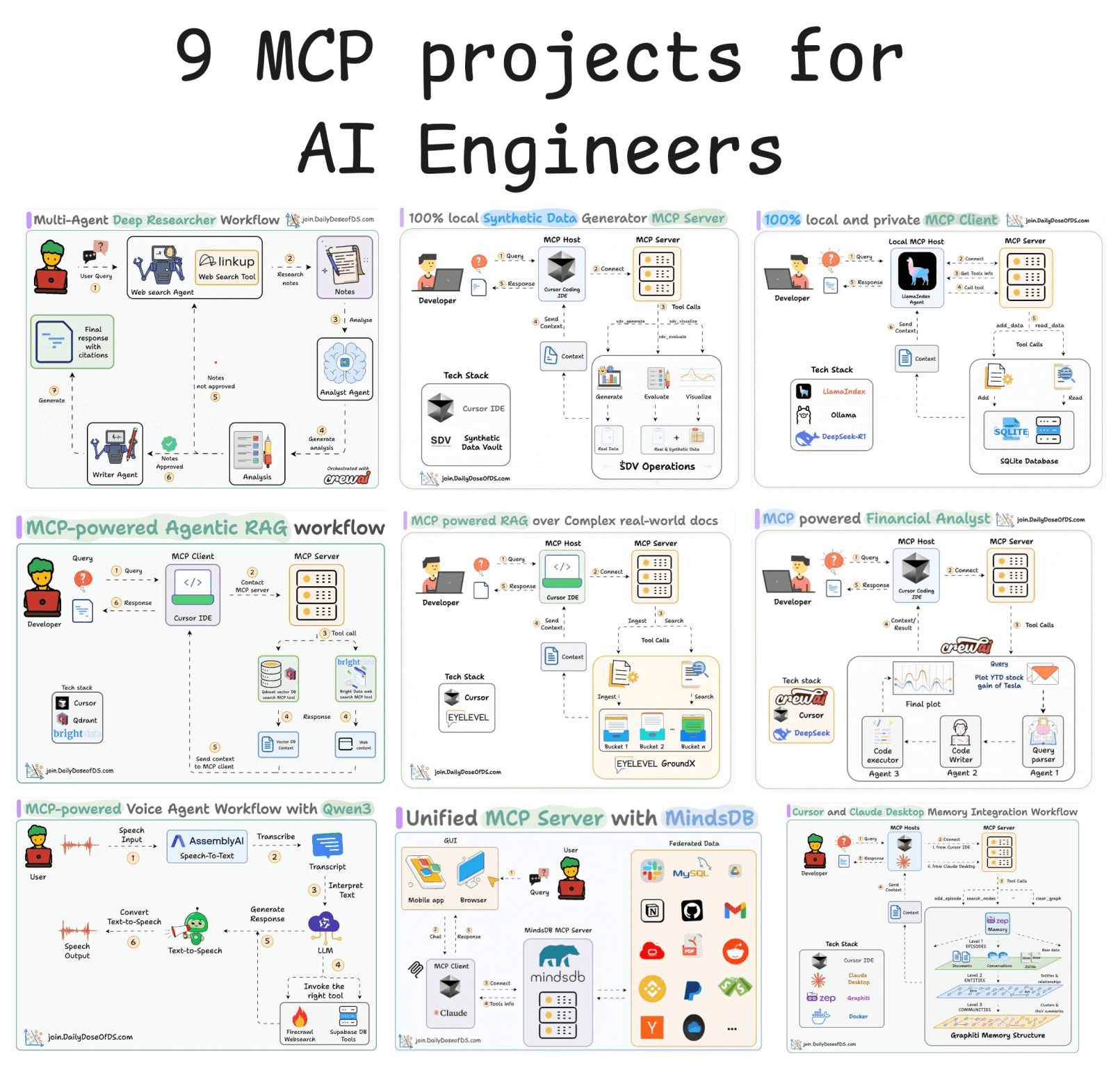
9 MCP projects for AI Engineers
We have covered several MCP projects in this newsletter so far.
Here’s a recap along with visuals & full code walk-through issues:
#1) 100% local MCP client
An MCP client is a component in an AI app (like Cursor) that establishes connections to external tools. Learn how to build it 100% locally.
#2) MCP-powered Agentic RAG
Learn how to create an MCP-powered Agentic RAG that searches a vector database and falls back to web search if needed.
#3) MCP-powered financial analyst
Build an MCP-powered AI agent that fetches, analyzes & generates insights on stock market trends, right from Cursor or Claude Desktop.
#4) MCP-powered Voice Agent
This project teaches you how to build an MCP-driven voice Agent that queries a database and falls back to web search if needed.
#5) A unified MCP server
This project builds an MCP server to query and chat with over 200+ data sources using natural language through a unified interface powered by MindsDB and Cursor IDE.
#6) MCP-powered shared memory for Claude Desktop and Cursor
Devs use Claude Desktop and Cursor independently with no context sharing. Learn how to add a common memory layer to cross-operate without losing context.
#7) MCP-powered RAG over complex docs
Learn how to use MCP to power an RAG app over complex documents with tables, charts, images, complex layouts, and whatnot.
#8) MCP-powered synthetic data generator
Learn how to build an MCP server that can generate any type of synthetic dataset. It uses Cursor as the MCP host and SDV to generate realistic tabular synthetic data.
#9) MCP-powered deep researcher
ChatGPT has a deep research feature. It helps you get detailed insights on any topic. Learn how you can build a 100% local alternative to it.
👉 Over to you: What other MCP projects would you like to learn about?
Good day!


